
Social Media Marketing
Social Media That Builds Familiarity, Trust, and Business Opportunity
Social media is more than a place to post company updates or keep a profile active. It is one part of a complete digital marketing strategy that can help people discover your business, understand your expertise, and feel more confident before contacting you.
Social media only earns its place in the budget when it is doing something for the business beyond existing, which is the bar we hold it to. That may mean educating prospective customers, showing the people behind the company, distributing useful website content, strengthening local recognition, supporting paid campaigns, or staying visible during a longer buying decision.
After years of watching businesses publish content without a clear purpose, we have learned that consistency alone is not enough. Posting frequently does not help when the content is generic, the audience is wrong, or there is no connection between the post and the next step. Social media works best when it supports the website, search strategy, local visibility, paid advertising, and customer journey.
What Is Social Media?
Social media refers to online platforms where people and businesses communicate, share information, watch videos, ask questions, compare options, and form opinions about brands. These platforms include Facebook, Instagram, LinkedIn, YouTube, TikTok, X, and other digital communities.
For a business, social media can help the company:
- Build brand awareness
- Educate potential customers
- Share expertise
- Promote services
- Drive traffic to the website
- Support broader SEO and AI Visibility efforts
- Increase engagement with the audience
- Strengthen credibility and trust
- Stay visible in front of prospects over time
Social media rarely moves every prospect directly from a post to a purchase. More often, it becomes one of several touchpoints that help a person remember the company, verify its credibility, and decide whether to take the next step.
Why Is Social Media Important to My Business?
Customers often check social profiles after finding a business through Google, an advertisement, a referral, or an AI recommendation. They may want to see whether the company is active, whether its content is helpful, and whether the people behind it appear credible and approachable.
An outdated or inconsistent profile can create uncertainty. A professional presence with useful content, current information, real people, and a clear point of view can reinforce confidence before the first conversation.
Social media also helps businesses stay visible during longer decision cycles. Not every prospect is ready to call today. Some are comparing providers, learning about a problem, or waiting for the right time. Helpful content gives the company a way to remain familiar without relying only on promotional messages.
What Can Social Media Provide to Your Digital Marketing Strategy?
Social media can support visibility, trust, content distribution, audience research, customer communication, and lead generation. The value depends on how well the content matches the audience and the role each platform plays in the customer journey.
1. Brand Awareness
Consistent exposure helps people recognize the business and remember what it does. That recognition can matter when a need develops later, especially in industries where the buying decision is not immediate.
2. Trust and Credibility
Educational posts, team introductions, customer stories, service explanations, community involvement, and behind-the-scenes content can make a company feel more transparent and approachable. These signals should be specific and authentic rather than polished claims that could belong to any competitor.
3. Website Traffic
Social content can direct interested users to service pages, blog posts, case studies, videos, forms, and other resources. The destination needs to continue the conversation started by the post. A broad social message linked to an unrelated homepage often loses the visitor.
4. SEO Support
Social engagement is not a direct replacement for SEO and does not guarantee rankings. It can support the broader strategy by distributing content, increasing brand searches, generating referral traffic, helping useful resources reach potential link sources, and giving more people a reason to search for the company by name.
5. AI Visibility Support
Social profiles and public content can contribute to the wider digital footprint around a brand. Consistent descriptions of services, locations, people, and expertise may help reinforce entity clarity, but social posting alone does not guarantee inclusion in AI-generated answers.
6. Audience Engagement
Comments, messages, reactions, and questions reveal what the audience understands, what it doubts, and what it wants explained. Those conversations can become useful input for service pages, FAQs, videos, campaigns, and sales conversations.
7. Paid Advertising Support
Organic content can help establish credibility before or after someone sees a paid social ad. Facebook, Instagram, LinkedIn, and YouTube also provide targeting options based on location, interests, behavior, professional characteristics, website activity, and customer data, subject to each platform’s policies.
Why Social Media Is Critical to the Success of Your Digital Marketing Strategy
Customers rarely move through one channel in a straight line. A prospect may see a Facebook ad, search the business on Google, read reviews, visit the website, watch a video, follow the company, and return weeks later to make contact.
Social media helps connect those moments. It can reinforce the message a person saw elsewhere, answer a question that delayed the decision, introduce a team member, or bring the prospect back to a useful page on the website.
A complete strategy may include SEO, Local SEO, AI Visibility, Paid Ads, website optimization, intake systems, and content marketing. Social media provides additional ways to distribute that work and communicate with the audience. It should support the system rather than operate as a separate calendar of disconnected posts.
Social Media Helps Turn Attention Into Action
The goal is not simply to collect likes or followers. Those numbers can show whether content is reaching people, but they do not prove the content is creating business value. A useful strategy guides the audience toward actions such as visiting a service page, watching a longer video, sending a message, joining an event, downloading a resource, or contacting the company.
Effective social media content may include:
- Educational posts
- Short videos
- Service explanations
- Customer success stories
- Frequently asked questions
- Industry updates
- Team introductions
- Community involvement
- Case study highlights
- Promotional campaigns
- Calls to action that direct users to useful website content
The strongest content usually comes from the questions the team answers every day, the objections prospects raise, the changes happening in the industry, and the firsthand experience the business can explain better than a generic content generator.
Social Media and SEO Work Better Together
SEO helps the business appear when people actively search. Social media helps distribute the expertise behind those pages and maintain familiarity before and after the search.
A detailed blog can be divided into several short posts. A service page can become a series of videos answering common questions. A case study can support a social post that links to the full story. This approach creates more value from existing knowledge without copying the same caption across every platform.
Social Media and AI Visibility
AI Visibility depends on clear, consistent, and credible information across the web. Social profiles can support that foundation when they accurately describe the business and publish content tied to its real services and expertise.
The relationship should not be overstated. An active social account does not automatically cause an AI platform to recommend the business. Website quality, search visibility, reviews, citations, authoritative mentions, structured information, and the platform’s own retrieval process still matter.
What Makes a Social Media Strategy Successful?
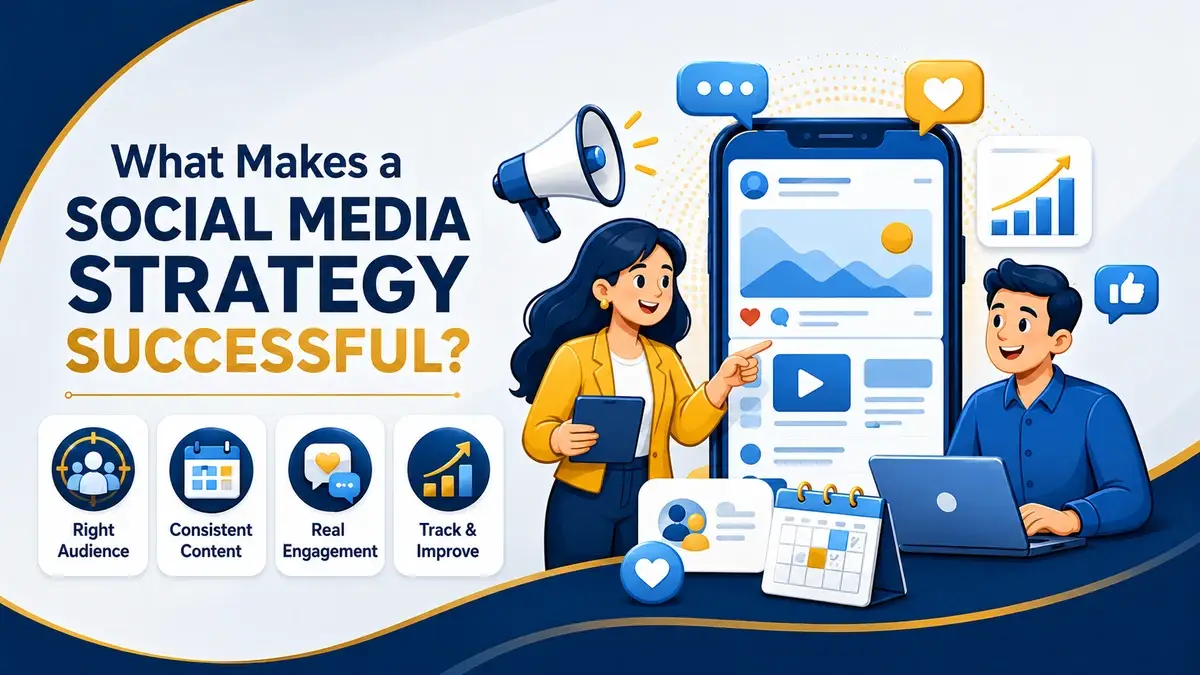
A successful strategy is built around audience fit, useful content, recognizable branding, consistent execution, and a clear reason for publishing. Posting simply to fill a calendar usually produces content that feels repetitive and interchangeable.
A strong social media strategy should include:
- Clear brand messaging
- A realistic posting schedule
- Professional visuals
- Educational content
- Service-focused content
- Audience-specific messaging
- Strong calls to action
- Relevant website links
- Platform-specific content
- Performance tracking
Performance should be evaluated according to the purpose of the content. An awareness video may be judged by reach, watch time, and profile activity. A service campaign may be judged by clicks, qualified messages, forms, appointments, or assisted conversions. Using the same metric for every post leads to poor decisions.
Social Media Platforms for Business Growth
Different platforms serve different audiences and content habits. The right choice depends on the business, customer, industry, available creative resources, and sales process.
Facebook can support local visibility, community engagement, groups, reviews, events, retargeting, and paid advertising.
Instagram is useful for visual branding, short-form video, company culture, service demonstrations, and audience engagement.
LinkedIn is often a better fit for B2B services, recruiting, professional networking, leadership content, and reaching decision-makers.
YouTube can support longer educational content, search visibility, demonstrations, interviews, and videos that continue producing value after publication.
TikTok can help businesses suited to short-form video reach broader audiences, but it requires content that fits the platform rather than corporate videos repurposed without adjustment.
The goal is not to maintain every platform. It is to choose the channels where the audience can realistically be reached and where the business can consistently create appropriate content.
Social Media Content Should Support Your Business Goals
Every post should have a job. Some content builds awareness. Some explains a service. Some addresses an objection. Some creates conversation. Some directs people to a website resource or offer.
Your social media strategy may support goals such as:
- Generating qualified leads
- Increasing relevant website traffic
- Improving brand recognition
- Supporting broader SEO and AI Visibility efforts
- Promoting specific services
- Building trust with potential customers
- Improving customer engagement
- Strengthening the local presence
- Supporting paid advertising campaigns
Social media becomes more valuable when the business can explain how the content supports those goals and what happens after the audience engages.
Why Choose Digital Growth Pros for Social Media Marketing?
Digital Growth Pros connects social media to the rest of the marketing system. We look at the questions customers ask, the services the business wants to grow, the pages that need support, the markets being targeted, and the actions a prospect should take next.
We do not believe every company needs to post every day or chase every trend. The strategy should match the audience, the available resources, and the value the business can consistently provide. A smaller number of useful, recognizable posts can be more effective than a high-volume stream of generic content.
Build a Stronger Social Media Presence
Social media can help your business remain visible, demonstrate expertise, and support trust across the customer journey. Its strongest role is often reinforcing the website, search presence, advertising, reviews, and people behind the company.
To build a social media strategy that works with SEO, AI Visibility, Paid Ads, and the rest of your digital marketing, contact Digital Growth Pros to discuss the platforms, content, and business outcomes that matter most.